

Do Dachshunds Really Need Special Harnesses?
If you’ve recently welcomed a dachshund into your family, you’ve probably wondered…
“Do they really need a special harness, or is that just clever marketing?”
It’s a fair question.
After personally fitting thousands of dachshunds, designing harnesses specifically for the breed, and testing countless samples over the years, my answer is simple:
Yes… but probably not for the reasons you think.
It’s not just because dachshunds have long backs.
It’s because no two dachshunds are built the same.
The Biggest Lesson Thousands of Dachshunds Have Taught Me
People often assume a dachshund is a dachshund.
I certainly did when I first started.
But after fitting literally thousands of them, one thing has surprised me more than anything else…
Not one has been the same.
Every time I think I’ve seen every possible shape, another dachshund proves me wrong.
Some have incredibly deep chests that almost reach their ankles (like our CEO, Oreo). Others are surprisingly narrow. Some are long-bodied with a slim waist, while others naturally carry more weight around their middle. Standard dachshunds differ enormously from miniatures, and even two dogs of the same age and size can need completely different adjustments.
That’s why a harness shouldn’t simply “fit the measurements.”
It should adjust to the individual dog.
Measurements are a fantastic starting point, but they’re not the whole story. That’s why we often ask customers for photos alongside their dog’s measurements and weight. Tape measurements can be taken differently, proportions vary enormously, and a photo tells us things numbers simply can’t.
What Happens When a Harness Isn’t Designed for a Dachshund?
Over the years, I’ve seen the same problems appear again and again.
The most common issue?
Harnesses riding into the armpits.
This is by far the biggest problem we see.
A harness might look fine while the dog is standing still, but the moment they start walking, sniffing or running, the chest plate shifts backwards and begins rubbing behind the front legs.
I’ve also seen harnesses that:
- Bulge away from the chest instead of sitting flat.
- Dig into the front legs because the chest plate is too short.
- Restrict natural shoulder movement with straps running directly across the shoulders.
- Sit too tight around the neck or waist because they weren’t designed for a dachshund’s proportions.
- Cause rubbing, hair loss and, in some cases, skin injuries.
Unfortunately, we’ve even had customers send us photos of dogs with cuts and significant hair loss caused by poorly fitting harnesses.
A harness should never fight against your dog’s movement.
It should move with them.
Why Generic Small Dog Harnesses Often Miss the Mark
One of the biggest myths I hear is:
“Any small dog harness will do.”
The problem is that most small dog harnesses are designed around an average small breed.
Dachshunds aren’t average.
Their chest shape is unique. Their proportions are unique. Their movement is unique.
Simply scaling down a generic harness doesn’t suddenly make it suitable for a dachshund.
A properly designed dachshund harness should:
- Accommodate their deep chest without digging into their legs.
- Allow complete freedom of shoulder movement.
- Sit flat against the chest without bulging.
- Distribute pressure evenly across the front of the chest.
- Stay supportive without shifting during movement.
- Be adjustable enough to suit the huge variation within the breed.
What We Learned by Saying “No”
One thing many people don’t realise is how many designs never make it to market.
We’ve rejected plenty.
One example was an “adventure-style” harness.
Getting dogs into it was easy, but once fitted it was simply too stiff. It didn’t sit flat against the chest and didn’t provide the support I wanted for dachshunds.
Another lesson came while developing our step-in harness.
Many step-in designs angle the waist strap back towards the dog’s head. On paper, it looks fine.
In reality?
It’s basic physics.
If you try to combine an angled waist strap with a genuinely longer chest plate, the harness naturally wants to curve. That curve creates bulging through the chest or rubbing behind the front legs.
You simply can’t have all three:
- An angled waist strap.
- A long supportive chest plate.
- A perfectly flat harness.
Something has to give.
That’s why you’ll often see brands advertising a longer chest plate on these styles, but the geometry simply doesn’t allow it to work the way people think.
Testing these designs taught us that what works beautifully for one or two dogs doesn’t necessarily work for the breed as a whole.
Even We Changed Our Minds
One of the biggest lessons I’ve learned is that expertise doesn’t come from being right the first time.
It comes from being willing to change your mind.
Developing our step-in harnesses has taken far longer than expected because we refused to release something just because people wanted it.
We’ve watched similar products launch elsewhere and recognised many of the same problems we’d already discovered during testing.
On the flip side, I’ve also learned that most dachshunds can absolutely learn to wear an overhead harness with gentle, positive reinforcement.
I say “most” because…
Well…
They’re dachshunds.
They’re wonderfully stubborn.
How to Tell if Your Harness Actually Fits
Here’s a simple checklist I recommend to every dachshund owner.
Your harness should:
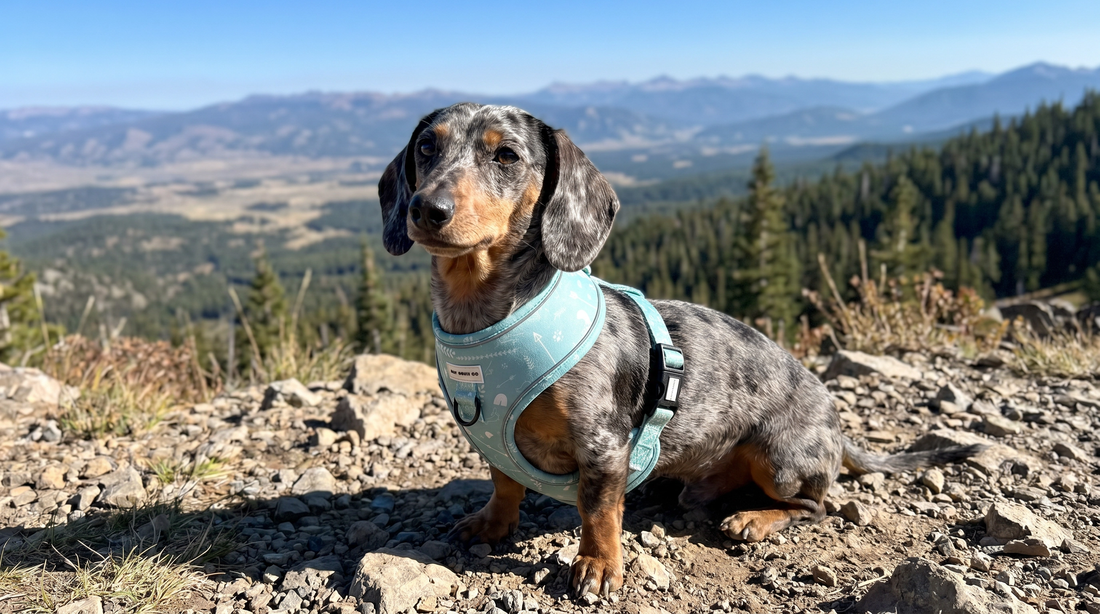
✔ Sit just above the breastbone.
✔ Have a chest plate that lies completely flat without bulging.
✔ Leave clearance behind the front legs, even when your dog stretches forward.
✔ Move with your dog as they walk, sniff, run and play.
If it shifts, twists, bulges, digs in or rides backwards, something isn’t right.
Remember…
Harness fitting is dynamic, not static.
Standing still tells you very little.
Always watch your dog move.
The Biggest Myths I Hear
Some of the most common misconceptions I hear include:
- “Any small dog harness will do.”
- “If it isn’t rubbing, it fits.”
- “It only matters if my dog pulls.”
- “Thicker materials automatically mean hotter harnesses.”
- “The brand owner has dachshunds, so it must fit all dachshunds.”
The last one is especially important.
Just because someone owns dachshunds doesn’t automatically mean every product they sell is suitable for every dachshund.
Remember what we talked about earlier?
I’ve fitted thousands of them.
Not one has been the same.
If You Remember One Thing…
If there’s one thing I’d love every dachshund owner to take away from this article, it’s this:
A harness isn’t just another accessory.
It’s something your dog may wear for years.
An ill-fitting harness can contribute to skin problems, rubbing and interfere with natural movement over time.
Think about your own shoes.
You wouldn’t choose the cheapest pair if they were uncomfortable or affected the way you walked.
Your dachshund deserves the same consideration.
Invest in a harness that supports natural movement, fits your individual dog properly and keeps them comfortable every time they head out for an adventure.
Why This Matters So Much to Me
People sometimes ask why we’re so particular about harness design.
The answer is simple.
I’ve never been comfortable taking shortcuts.
If I know something isn’t right for dachshunds, I can’t put my name on it just because it might sell.
We’ve delayed launches.
We’ve rejected samples.
We’ve gone back to the drawing board more times than I can count.
Because trust takes years to build and only one poor decision to lose.
I’d much rather tell someone “not yet” than sell them something I wouldn’t happily put on my own dogs.


