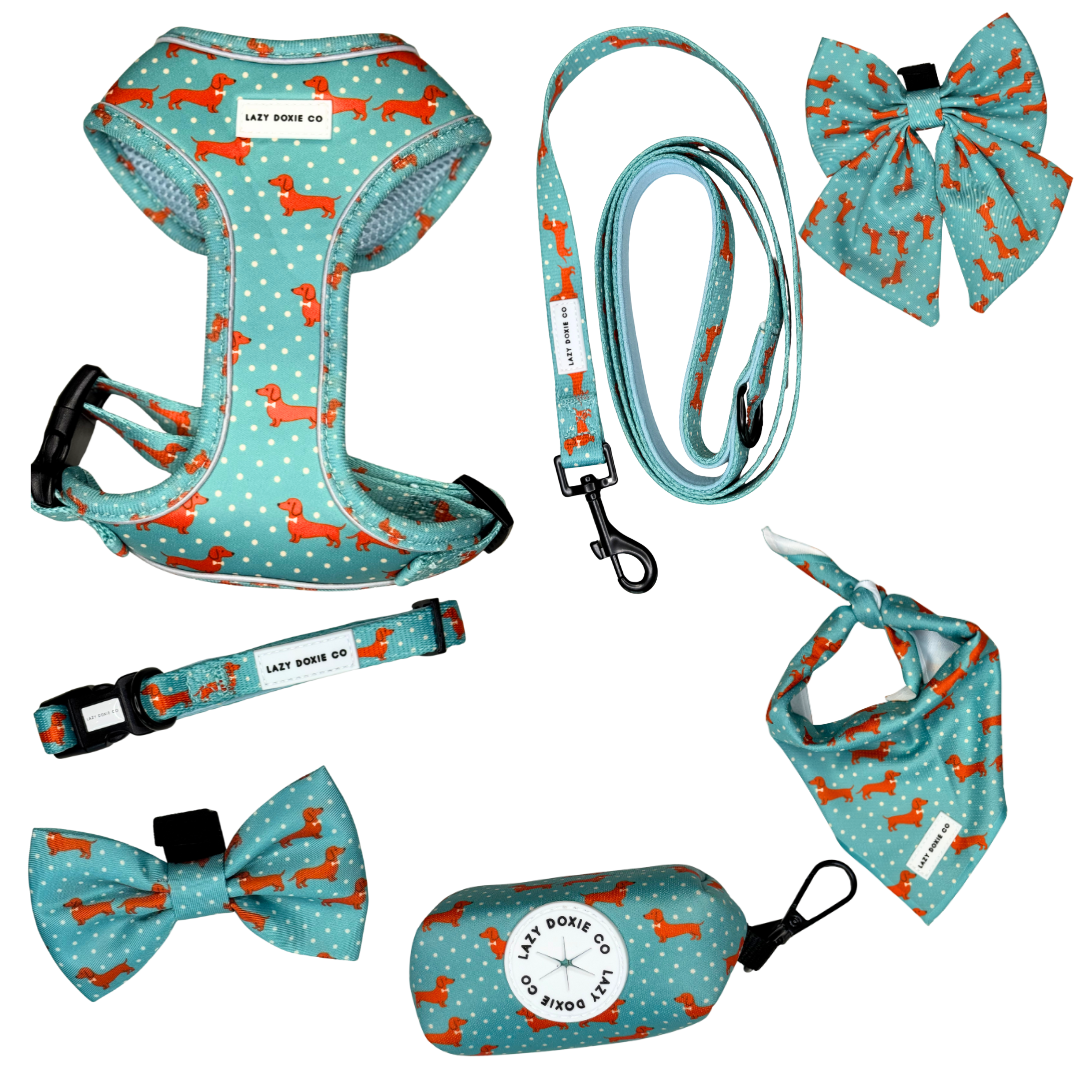


What Is the Best Harness for a Dachshund With a Bad Back?
If you’ve found yourself here, chances are you’ve either been told your dachshund has Intervertebral Disc Disease (IVDD), you’re worried they might be at risk, or you’re simply trying to do everything you can to protect their long back.
As a dachshund owner myself, I completely understand.
One of the questions I get asked most often in our fitting studio is:
“What’s the best harness for a dachshund with a bad back?”
The honest answer?
There isn’t one harness that will prevent IVDD.
But there are harnesses that allow your dachshund to move naturally, comfortably and safely—and there are others that can restrict movement, change the way they walk, and put unnecessary pressure where you don’t want it.
Let’s talk about why that matters.
First Things First: A Harness Can’t Prevent IVDD
This is probably the most important thing I want every dachshund owner to understand.
IVDD is primarily a genetic disease. While there is testing available, many dachshunds are never tested, so you often won’t know whether your dog carries the genes associated with the condition.
No harness, supplement or gadget can eliminate that genetic risk.
What you can do is reduce unnecessary strain on their body and support healthy movement throughout their life.
Think about it this way.
If you’ve ever pulled a muscle, you’ve probably limped or changed the way you walked because it hurt. Suddenly other muscles start working harder to compensate, your posture changes, and before long you’re sore in places that weren’t injured to begin with.
Dogs are no different.
When movement isn’t natural, the rest of the body compensates.
IVDD Isn’t Just About the Back
One thing I don’t think gets talked about enough is that IVDD doesn’t only affect the back.
Many people hear “dachshunds have fragile backs” and immediately think that’s the only area they need to worry about.
But IVDD can also occur in the neck (cervical IVDD).
That changes the conversation around harnesses.
For some dogs recovering from cervical IVDD, their veterinarian may recommend a step-in harness rather than one that goes over the head, simply to avoid unnecessary movement through the neck during recovery.
We’ve experienced this ourselves.
We’ve had customers whose dachshunds have happily worn our overhead Y-front harnesses after recovering from IVDD.
We’ve also had customers whose vets specifically recommended a step-in harness following neck surgery or cervical IVDD.
At the time, we didn’t have a step-in harness that met our standards.
Could we have rushed one to market?
Absolutely.
Did we?
No.
Instead, we spent months testing different samples until we were confident we had created a version that still supported proper dachshund movement while offering the convenience some recovering dogs needed.
Every IVDD case is different.
Your veterinarian or rehabilitation professional should always guide what is most appropriate for your dog’s recovery.
My Philosophy on Choosing a Harness
I don’t believe the “best” harness is the one that’s easiest for us to put on.
I believe it’s the one that allows the dog to move naturally.
A good harness should work with your dachshund’s body—not against it.
That means:
- distributing pressure across the chest rather than the neck
- allowing full shoulder and leg movement
- supporting the chest without restricting stride
- sitting comfortably away from the front legs
- moving with your dog instead of forcing them to adapt to the harness.
When I watch a dachshund walk in a harness, I don’t just look at how it fits.
I watch how they move.
Their gait should look natural, balanced and symmetrical.
If they’re taking shorter steps, shuffling, waddling, or changing the way they move because of the harness, something isn’t right.
The Biggest Mistakes I See Dachshund Owners Make
After fitting countless dachshunds, there are a few mistakes I see over and over.
Choosing cute over comfort
We all love adorable harnesses.
I do too.
But functionality, comfort and safety should always come before the print.
A beautiful harness that restricts movement isn’t doing your dachshund any favours.
“It’s easy to put on.”
This is probably my biggest pet peeve.
Many harnesses are designed to make life easier for us—not the dog.
Just because something is quick to clip on doesn’t automatically make it good for your dachshund.
In fact, many “easy-on” styles achieve that convenience by sitting across areas that need to move freely when your dog walks.
Easy for the human doesn’t always mean comfortable for the dog.
“My dog doesn’t pull.”
I hear this one all the time.
Maybe they don’t.
But you can only predict your dachshund.
You can’t predict the world around them.
A loud noise.
Another dog.
A cyclist.
A bird.
A rabbit.
Something unexpected can cause even the calmest dog to lunge or pull suddenly.
A properly fitted harness helps distribute that force across the chest instead of concentrating it around the neck.
Assuming all small dog harnesses are suitable
Just because a harness comes in an XXS doesn’t mean it was designed for dachshunds.
Long bodies.
Deep chests.
Short legs.
Different shoulder movement.
Dachshunds aren’t just “small dogs.”
They’re built completely differently.
What I Look For in a Dachshund Harness
Whether it’s one of our own designs or a sample we’re testing, these are my non-negotiables.
1. A Proper Y-Front Design
A Y-front harness helps distribute pressure evenly across the chest and away from the neck and spine.
This allows the shoulders to move much more naturally than designs that sit straight across the front of the chest.
2. Real Chest Support
I don’t believe a single narrow strap provides enough support.
A chest plate with appropriate width and padding helps distribute pressure more evenly across the chest.
3. A Longer Chest Plate
Dachshunds have long bodies.
Their harness should acknowledge that.
A longer chest plate helps support more of the chest while working with the shape of their body.
4. A Waist Strap Positioned Correctly
The waist strap should sit well behind the front legs.
When it’s too close to the elbows it can rub, interfere with movement and affect the way the chest plate sits.
5. Natural Movement
This is the biggest one.
If the harness changes the way your dachshund walks, I don’t want it.
Simple.
What We’ve Learned Through Product Testing
One thing people don’t often see is just how many products never make it to our shelves.
We’ve rejected harnesses because:
- the waist strap sat too close to the front legs
- the chest plate bulged away from the body
- the harness sat too low across the shoulders
- angled straps caused the chest plate to twist and curve instead of sitting flat
- chest plates were too stiff to move comfortably with the dog
- the design restricted natural shoulder movement.
We’ve even rejected harnesses with handles.
Now, I know that surprises people.
The problem isn’t the handle itself.
The problem is what people naturally do with it.
Even with the best intentions, it’s very easy to instinctively grab or lift a dachshund using the handle.
Personally, I never want to encourage that.
A dachshund should never be lifted by a harness handle.
If there’s a handle, it should only ever be used to briefly steady or hold your dog—not to carry them.
Every Dachshund Is Different
One of the biggest lessons we’ve learned is that there is no such thing as an “average” dachshund.
We’ve tested harnesses on our own dogs.
We’ve tested them on customers’ dogs.
We’ve tested them on long dachshunds.
Shorter dachshunds.
Deep-chested dachshunds.
Slim dachshunds.
Broad-shouldered dachshunds.
Coated and smooth-haired dachshunds.
We’ve had designs that looked perfect on one dog and completely failed on another.
That’s why we don’t believe in designing around just one or two dachshunds.
If a harness only fits one body shape well, it isn’t good enough.
One Opinion I’ll Happily Stand Behind
This might be controversial.
But I believe many so-called “easy-on” harnesses are designed to make life easier for humans—not dogs.
Imagine someone loosely tied a rope around the top of your legs.
Now try walking naturally.
You probably wouldn’t.
You’d shorten your stride.
Shuffle.
Compensate.
That’s exactly why freedom of shoulder and leg movement matters so much.
Your dachshund deserves to walk naturally.
Not adapt their movement to suit their equipment.
The Five Things I’d Look For in a Harness for a Dachshund With IVDD
If you’re shopping around, these are the five things I’d prioritise.
- A Y-front design.
- A supportive chest plate that distributes pressure across the chest—not just thin straps.
- A longer chest plate suited to a dachshund’s body.
- No lifting handle.
- A harness that sits flat, moves with your dog and allows completely natural shoulder and leg movement.
And if your dog has already been diagnosed with IVDD—particularly cervical (neck) IVDD—always follow your veterinarian’s recommendations when choosing the most appropriate harness style.
My Final Thoughts
If there’s one thing I’d love every dachshund owner to remember, it’s this:
Protect them, but don’t wrap them in cotton wool.
You can’t change your dog’s genetics.
But you can help them move well.
Keep them at a healthy weight.
Build their strength.
Choose equipment that works with their body, not against it.
Healthy movement today helps build the muscles that support them tomorrow.
And if they ever do face IVDD, giving them the best opportunity to move naturally throughout their life is one of the greatest gifts you can give them.


